Her Startup Cohort 2.0 Sets a Revenue Test for Young African Women Founders
Her Startup Cohort 2.0 is open to young African women founders with technology-enabled businesses, but its revenue requirement keeps the programme focused on operators already in market.
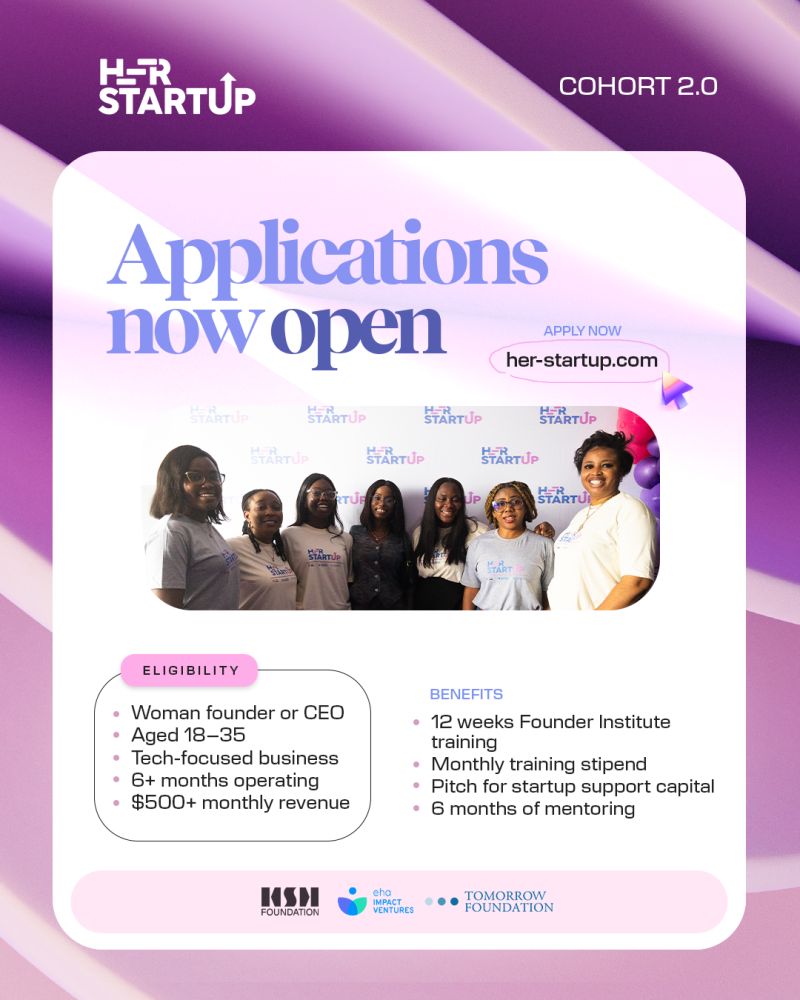
Her Startup Cohort 2.0 has opened a new application window for young African women founders, with a structure that makes one thing clear: this is aimed at operators already in market, not applicants with an idea alone.
The programme is described as a pan-African accelerator for women founders, co-founders and chief executives aged 18 to 35 who are running technology-enabled businesses. The current eligibility requirements include having a minimum viable product or existing product in the market and generating at least US$500 in monthly revenue for a sustained period.
That revenue threshold is the most important detail. It filters the programme toward founders who have already found some customer demand, even if the business is still small. For early-stage support, that can be a useful distinction. Idea-stage founders need education and validation. Revenue-generating founders need different help: sharper unit economics, stronger customer acquisition, better records, mentor access and a clearer route to funding.
The support package is also practical. The programme is reported to include a 12-week accelerator delivered through the Founder Institute, a monthly stipend during training, six months of mentorship and an opportunity for participants who complete the training to pitch for up to US$5,000 in startup capital. That funding is not automatic, which is an important boundary for applicants to understand.
For women founders across African markets, the offer sits in a familiar gap. Many businesses are too advanced for beginner entrepreneurship content but too early, too small or too under-networked for conventional investors. A founder may have customers, a working product and clear demand, yet still lack the advisory support to make the business investable or scalable.
Her Startup's technology-enabled focus also matters. The eligible sectors named in current opportunity listings include areas such as healthcare, financial services, education, agriculture and digital services. That range is broad enough to include women building practical tools for real markets rather than only venture-style software companies.
The age range makes the programme especially relevant for younger founders who are already carrying serious operating responsibility. A 25-year-old chief executive with six months of revenue history is not simply learning entrepreneurship in theory. She is making pricing, hiring, customer, compliance and product decisions with real consequences.
The application deadline gives the story its immediate hook, but the strategic question is deeper: how can accelerator capital and training be designed for women who have already proved enough demand to deserve the next layer of support?
If Her Startup Cohort 2.0 reaches founders beyond the most visible networks, it could help turn early traction into stronger companies. The test will be whether the programme's training, stipend, mentorship and pitch pathway translate into measurable operating progress for the women selected.
Stay close to the story
Subscribe to the newsletter
One edition a week from the SheMeansNews desk.